
How New Equipment is Changing Seam Testing
The leister 100-lp is changing the way we test for compromised seams
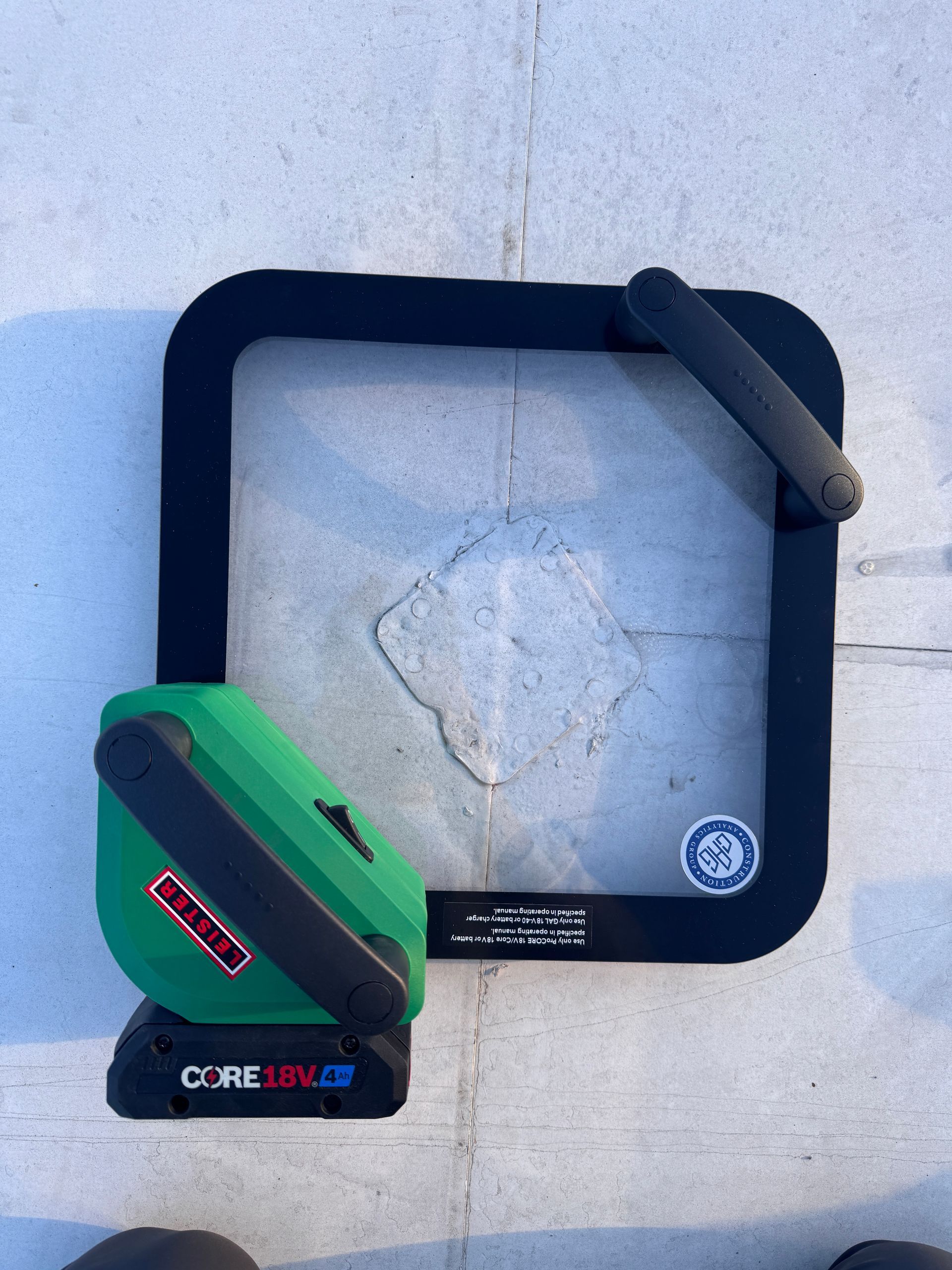
The older methods in which one tests for compromised seams of thermoplastic membranes - including PVC, and TPO - mainly include manual prodding of welded seams. Welding of thermoplastic membranes is an art - and one that is not easily mastered. Similarly, so is manual probing to test for seam integrity. This leads us to quite the conundrum. When any skill or test method requires individual mastery, it opens the door to subjectivity related to what should be considered acceptable.
The Leister LP-100 product is a simple, yet brilliant piece of equipment. Just like checking for air leakage on a punctured tire, one applies a soapy water solution to the subject area being tested. Then, the LP-100 is placed over the test area and turned on. A vacuum pump applies negative pressure above the thermoplastic membrane, thanks to a well-designed gasket at the perimeter of the plate. Assuming a failed or compromised weld or seam, one can see active bubbling from air leakage sourced from the substrate. So much for being "monolithic" if that's the case...
I have always been a proponent of prioritizing visuals. Adequate visuals convert critics into believers. Not to mention such visuals eliminate the subjectivity and ambiguity of old-school prodding methods. "Well, you just prodded to hard..." (see what I mean?)
That leads us to the best part. The ability to photograph the entire test in real time through an intuitive viewing pane.
This tool is quick, user friendly, designed for those wishing to present the facts. It's a tool that's perfect for quality assurance observation and forensic testing. Not to mention it's yet another piece of equipment perfect for integration when evaluating in accordance with ASTM D7053/D7053M "Standard Guide for Determining and Evaluating Causes of Water Leakage of Low‑Sloped Roofs".
Onward and upward!